KALININGRAD/KÖNIGSBERG
RUSSIAN FEDERATION
RUSSIAN FEDERATION
Train Leominster to Manchester Airport £10.55
Ryanair flight to Gdansk, Poland £24.47 Taxi to Gdansk Bus Station £4
Bus Gdansk - Kaliningrad Russia £9.51 Total travel cost to Russia £48.53
I arrived at the frontier with no visa, only an email from a man
called Timur -
“Dear Joe Cocker, Everything
is OK. Please don't forget colored photo. In special case call me mob. +79062389788.”
Having experienced the usual hassle of Russian visas this was a
novel experience.
PREAMBLE
Tuesday January
26th 2010.
I arrived in Klaipeda, Lithuania with my
Lithuanian friend Jovita. Klaipeda is the main port and third city of
Lithuania. It was once the German city
of Memel. From Klaipeda it is a short ferry ride to the Curonian Spit. This is
a 100 km long strip of land ranging from 400 metres wide to nearly 4 kms. It is
wooded and the coast is backed by sand dunes . The southern half is in the
Russian exclave of Kaliningrad. The
northern part is in south west Lithuania. It almost entirely encloses the
Curonian lagoon only the northern part of which is open to the sea at Klaipeda.
I had read about this geographic curiosity
and despite it being winter thought at least a short visit would be interesting. Winters are cold in this part of the world
but this winter was exceptionally cold and the normally ice-free port was
closed to traffic, you could walk on the sea. An icebreaker had made a channel
for the ferry and with the temperature around minus 25 celsius Jovita and I
made the crossing. It was a large ferry but there were very few passengers most
of whom huddled inside. On the Spit the snow was around 20 – 30 cms deep and so
even walking around was difficult.
There was
hardly a soul about but curiously we came to a tourist information office that
was open. There were three ladies inside and they told Jovita that they would
like to have made us coffee but the water was frozen. There was a museum of
fishing vessels nearby but nothing else.
Just then a lone bus appeared, on the front it said клаипеда i.e. Klaipeda. After discharging its passengers the
destination board was altered to Калининград i.e. Kaliningrad 135 kms to the south. It must
have been quite a journey through the forest in that snow but then Russians
have some experience of this.
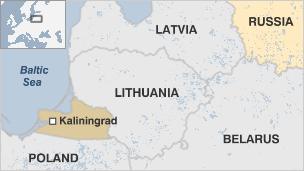
Kaliningrad is a Russian exclave, separated
from the rest of Russia by Poland, Lithuania and Belarus. I imagine that Belarus is not a problem but
for Russia the other two certainly are.
When in 2002 they became eligible to join the EU and NATO there were
fierce exchanges, Russians wanted the right to cross the divide but this was
not granted. One of the reports I read
from this time referred to the “tiny enclave” of Kaliningrad- more about that
later. Unless they have a visa other
Russians can now only go to Kaliningrad by sea or air. This is one of the
complications thrown up by the demise of the Soviet Union.
Fast forwarding for a moment this was brought
home on a flight from Vilnius to Liverpool. Beside me were a woman and 7 year old boy.
The boy spoke to me in English, in fact he wouldn’t stop talking! When I asked the woman her nationality she
said Russian. It turned out that she is
a Lithuanian citizen but one of the substantial Russian minorities in most of
the ex-Soviet states and now lives near Manchester. After all this time she
still thinks of herself first and foremost as Russian. I asked her if the fact that she is an
ethnic Russian makes it easier for her to visit Russia. Apparently not, she
needs a visa like all Lithuanians. It was interesting that she thinks of
herself as Russian and the ethnic Russians in these countries including Ukraine
deserve more understanding than they tend to get in the West. I told the lady
that I had been to Kaliningrad and she has relatives there but has not visited
for years because she needs a visa.
Back to the Curonian
Spit. Jovita and I trudged through the
snow along a road to where she thought there would be another ferry. I think we only met one person on the
way. Then a car came along, Jovita spoke
to the driver in Lithuanian and for 10 euros he agreed to drive us not only to
the ferry, but across on the ferry and to where we wished to go in
Klaipeda. Money well spent in the
conditions, I thought. So this was my
brief introduction to the Curonian Spit and even briefer one to the idea of
Kaliningrad.
A CURIOSITY Visiting Tobago many years ago I came across a monument to the
Courlanders who briefly colonised part of the island in the 17th
century. I later wondered if these
people were from the Curonian area, not so, but not so far away. Courland was a
duchy in Latvia, Lithuania’s northern neighbour.
FIRST ATTEMPT TO VISIT
KALININGRAD 2012
For a couple of
years after this I vaguely thought about making a short trip to Kaliningrad and
investigated various possibilities online. There was talk of ferry trips from
Gdansk and also bus trips. The internet is so often wonderful but at other
times information can be very hard to obtain.
In April 2012 after attending a conference in Copenhagen I flew to
Gdansk with a view to investigating the possibilities on the ground. I found very little, Poland and Russia are
not the best of friends and no one seemed to know of short trips. This was not a disaster for me as Gdansk
turned out to be a great place to visit.
You arrive at Lech Walensa Airport and there are many monuments to the Solidarity movement. I also visited the shipyards at Gdynia where
I found a pre WW2 Polish Navy ship that had been built in the Isle of
Wight. Between these two ports there is
a modern resort, Sopot, all in all, Dansk was well worth the visit and the
weather was superb.
SECOND ATTEMPT
TO VISIT KALININGRAD AUGUST 2014
Early in 2014 I
thought about Kaliningrad again. Online
I found Kaliningrad visa information at Konigsberg.ru. It is curious that the
website name is from the old German name of Kaliningrad. There I found that there is a special 72 hour
visa for Kaliningrad and only for Kaliningrad for various nationalities
including UK which costs 77 euros. Out
of interest I had downloaded the form for a standard Russian visa, a dense two
A4 page document requiring among other things a list of all the countries you
have visited in the last 10 years with dates! I have visited Russia five times
but am put off a further visit to mainland Russia by the cost and hassle of the
visa.
The 72 hour visa was much simpler and an email
produced a reply from a man called Timur with some information. In early August
I applied for the visa giving just name, address, occupation, a scan of my
passport and confirmation of a hotel room for three nights.The bank charged
£20 for transferring the money and so the visa cost a total of about £77
pounds, more than a pound per hour of visit!
I had to state which bus I would
be taking and said the 6.30 am bus from
Gdansk.
I received an
email from Timur,
On 18 August 2014 10:01, Timur Kuchushev
<kaliningradvisa@gmail.com> wrote:
Dear Joe Cocker,
Everything is OK. Please don't forget
colored photo. In special case call me mob. +79062389788.
Best regards, Timur.
That was it - no reference number or similar, just this
email – no mention even of a visa. Some might have thought this an elaborate
scam but it had the ring of authenticity for me even if it was a little bizarre
- a country renowned for its opaque bureaucracy delivering a visa in this way.
WE’RE ON OUR
WAY - GDANSK
I flew from
Manchester to Gdansk for a two night stay. On the Ryanair Boeing 737 I
reflected that my fellow passengers might not have enjoyed the flight I made before this one.. A couple of weeks before for my birthdayI treated myself to an aerobatic flight in a high powered Pitts Special
Biplane This included loops and rolls
such as a four point roll where you bank first to 90o, then 180o
when you are upside down and hanging in your straps (good idea to empty pockets
before flight!), then on round to 270o and back to level flight -exciting
stuff. It turned out to be a good cure
for the hangover from the birthday
celebrations.
I had booked
two nights at the Hotel Amber, Gdansk, in order to have time to buy my
Kaliningrad bus ticket.The hotel is a
little out of town but very comfortable and on a bus route, useful for the
return from town up a long steep hill. I
arrived late evening and after a leisurely breakfast next morning strolled down
the hill to town.
I found the bus station and there appeared to be only one window. I was expecting to have to produce passport and possibly other documentation for a visit to Russia. The woman at the window was of the school from Communist days, she had attended the Ena Sharples Charm Academy. (Younger readers should google Ena Sharples). I timidly said in Polish, ‘Kaliningrad tomorrow please.’ She replied ‘yes, 6 am?’ ‘Yes, please.’ ‘50 zloty’ she said. I handed over a 50 zloty note and she produced one of those flimsy till receipts. That was it, my transport to Russia sorted for less than £10. It seemed to take around 30 seconds but even allowing for exaggeration it cannot have taken more than one minute. That would not have been the case in the old days!
I found the bus station and there appeared to be only one window. I was expecting to have to produce passport and possibly other documentation for a visit to Russia. The woman at the window was of the school from Communist days, she had attended the Ena Sharples Charm Academy. (Younger readers should google Ena Sharples). I timidly said in Polish, ‘Kaliningrad tomorrow please.’ She replied ‘yes, 6 am?’ ‘Yes, please.’ ‘50 zloty’ she said. I handed over a 50 zloty note and she produced one of those flimsy till receipts. That was it, my transport to Russia sorted for less than £10. It seemed to take around 30 seconds but even allowing for exaggeration it cannot have taken more than one minute. That would not have been the case in the old days!
Now I was free
to spend the rest of the day renewing my acquaintance with Gdansk. The name
Amber Hotel reminded me that ‘amber’ is a name you find everywhere in this part
of the Baltic, the world’s greatest producer of Amber. As I was to discover Kaliningrad claims to be
the biggest single source of the precious stone and a whole room in the Winter
Palace, St Petersburg, now part of the Hermitage Museum is called The Amber
room, one of many sumptuously decorated rooms in the Hermitage. In my life I have known several people with
the surname Bernstein but I never realised until this journey that this is the
German name for Amber. (In Polish
Burstin, in Russian Yantar).
Another hotel I
have stayed in in the centre of Gdansk is called Wolne Miasto. This means Free City and refers to the fact
that Gdansk was once the free city of Danzig. The area had been part of various
empires and became part of the German Empire in 1871. After WW1 Poland became an
independent country once more and in accordance with the Treaty of Versailles
Poland was guaranteed access to the sea and the City-State of Danzig was
created but under the auspices of the United Nations and in the inter-war years
it had High Commissioners, four of whom were British. The population was over 90% German which led
to much discord.


New 'old' houses in Gdansk
I took a trip on a sailing ship like a pirate boat but with a good engine and
we sailed past the shipyards. These yards
were the birthplace of Solidarity and so here were sown seeds that led
eventually to the dissolution of the Soviet Empire.The boat sailed on to Westerplatte where, on
September 1st 1939, the first shots of WW2 were fired by Nazi forces
on the Polish Garrison there. It
reminded me that a couple of years
before I stood on the spot in Sarajevo where Gavril Princip fired the shots
that killed the Austrian Archduke and his wife and precipitated WW1. Footprints
on the Sarajevo pavement make the alleged exact spot of the incident and there
is a nearby museum.
Since
my previous visit Gdansk had acquired a smaller version of the London Eye, but
quite spectacular. My only companion in the car was a young man from Ukraine and we talk about that troubled
country which I have visited twice. You
have to gently ascertain whether a Ukrainian is a Western, Ukrainian speaking
citizen, or an ethnic Russian one, my companion was the first.
A Swiss couple
on the boat chatted about their tour. As we drank a beer on deck in the
sunshine I told them that my main aim was to visit Kalingrad and the
preparations I had made but they were politely sceptical. I am pretty sure they thought I would never
get there. Some very pleasant folk
music was being broadcast, at least so I thought. On leaving the ship we
discovered that the music was live, a man dressed like an old fashion sailor
sang and played his guitar.
One of the
things that will impress most people on first visiting Gdansk is the number of
impressive “old” buildings. Old in parentheses because they did not exist 70 years ago, central Gdansk was
reduced to rubble by allied bombing.
However buildings that you might think were 17th century have
been built since WW2. The main church is enormous, the largest parish church in
Poland.
ON TO RUSSIA
In the morning
my taxi arrived at 5.30 and it took only a few minutes to get to the bus
station. My till receipt told me that
the bus would leave from Platform 11. I thought it was due to leave at 6.30 but
it was 6.00 but luckily I was in good time. The Russian bus pulled in and some passengers,
all women, put their luggage in the hold at the back. I asked the driver if I
should put my rucksack in and he did it for me – without looking at my
ticket. On board he came round, had a
look at each ticket and away we went.
The countryside was rather boring and we stopped in a couple of places
to pick up a few more passengers and after about an hour we came to the
frontier. There were only 15 of us and
no other tourists as far as I could
tell.
There was a
long delay for no obvious reason and it was raining in almost monsoon downpours
with winds driving the rain sideways, it reminded me of an English Bank
Holiday. I was slightly concerned as I
had no official visa, only Timur’s email and was hoping that I would not have
to walk back across no mans’ land in the rain.
Eventually a Polish woman immigration officer entered the bus, young,
tall, slim, blonde ponytail, high heeled shoes and a gun. She took all our passports and
disappeared. After a while she brought
them back and we drove on to the Russian side.
Here in a reversal of expectations the Russian woman immigration officer
who boarded the bus was a plumpish, motherly good natured woman who joked with
some of the Russian speaking passengers. Again the passports were taken away
and eventually returned. We then had to all go to the immigration queue.
I had thought
most of our passengers were Russian but not so. While we were waiting in line
an officer came in and asked if there was anyone from Ukraine. Two women were and it was off to a special
office for them.They eventually
rejoined us and they may of course have been ethnic Russians from Eastern
Ukraine. Other passengers were from
Poland, Kazakhstan and Russia plus me. I was third in line to be called forward and wondering what I was going
to say, when a young woman rushed in with a sheaf of papers and said something
in Russian. It took me a moment to realise that she had said my name. Yes, she had my visa, checked the paperwork,
took the colour photo and peeled off a very smart visa and stuck it in my passport. Among other things it gave my full name in
Roman and Cyrillic script, кокер
джозеф габризл COCKER JOSEPH GABRIEL Good old Timur!
At the desk it
seemed my passport would not scan and so after several attempts the officer had
to type in all the numbers. A nervous
moment. All was well and the next thing
was to take our luggage through customs and scanners. The last time I entered Russia by bus was in
1962 at the Brest Litovsk crossing but that is another story. The books do warn of a lengthy delay at the frontier for what should be quite a short
trip, it is about 102 miles from Gdansk to Kaliningrad but it takes about 4.5
hours.
I stepped out at Kaliningrad bus
station and found myself surrounded by Russian speakers and in a forest of
Cyrillic. I tried to get my bearings because I thought my hotel was nearby but
I decided to take a taxi. He took me what seemed to be a long way round ,perhaps
to justify the fact that the hotel was a five minute walk away, but it may have
been due to the one way system. We passed through Lenin Square with its statue
of the great man, one of the few left in Russia apparently.
The Hotel
Berlin was very pleasant. An online report had suggested that single rooms were
on the small side so for the princely sum of around £35 per night I treated
myself to a junior suite. It was
wonderful, large sofa, table and armchair, desk, coffee and tea, disposable
slippers, large double bed, bathroom
with bathrobes as well as towels, very comfortable. One or two staff spoke a
little English but most did not.
So off to
explore Kaliningrad.
I looked up the area of Kaliningrad and found
it to be 223 kms2 (86 square
miles). At the bus station I had seen buses coming
and going from many destinations and it had taken 45 minutes to drive from the
frontier to Kalingrad and it would take more than that to drive to the Lithuanian
border in 3 days time. Then it dawned on me, Kaliningrad is also the name of
the entire region and the area of this is 15,100 kms2 or 5,830 miles2. This may be tiny by Russian standards but not by European ones. This makes it slightly
larger than Northern Ireland, much larger than Cyprus or nearly 50 times the
size of the independent republic of Malta.
Many people I have spoken to have never heard of Kalingrad.
Some of the
comments I read online before travelling said that Kaliningrad is boring with
little to do or see. One person said
that he visited and had ticked it off his list. However I thought I would
probably enjoy it and certainly would appreciate its strange political and
geographic situation.
On that first
afternoon I walked down the main street, LENINSKI PROSPECT. The pavements
showed what the guidebook said, that while Kaliningrad is advanced compared
with most of Russia it is still poor compared with its neighbours. The street
leads down to the Pregolya River with a wide bridge. Although my hotel was new
and very modern they could not produce anything like a town map and so I bought
one at a kiosk. Within a couple of hours
I had lost it and had to buy another from the same kiosk to the puzzlement of
the kiosk lady. The wide bridge over
the Pregolya or Pregel river is
effectively two bridges as it crosses over an island lining both sides of the
city to the island. In German times
there were seven bridges in Königsberg and this gave rise to a famous problem
in mathematics. I cannot do better than
give the Wikipedia explanation.
The Seven Bridges of Königsberg is a
historically notable problem in mathematics. Its negative resolution by
Leonhard Euler in 1735 laid the foundations of graph theory and prefigured the
idea of topology.The city of Königsberg in Prussia (now Kaliningrad, Russia)
was set on both sides of the Pregel River, and included two large islands which
were connected to each other and the mainland by seven bridges. The problem was
to find a walk through the city that would cross each bridge once and only
once. The islands could not be reached by any route other than the bridges, and
every bridge must have been crossed completely every time; one could not walk
halfway onto the bridge and then turn around and later cross the other half
from the other side (the walk need NOT start and end at the same spot). Euler
proved that the problem has no solution. There could be no non-retracing the
bridges. The difficulty was the development of a technique of analysis and of
subsequent tests that established this assertion with mathematical rigor.
So that is one
claim to fame for Kaliningrad. On the
island in the middle of the river there is a very well kept park lead down to
the old cathedral, now a concert hall
but once the Lutheran cathedral. It has been beautifully restored and although
nearly all the Germans were evicted from Kaliningrad after WW2 large numbers
now visit and the cathedral and other buildings have benefitted from German
money.
The main attraction for most people visiting
the cathedral is a mausoleum on the outside protected by pillars of pink
granite. This is the tomb of Immanuel Kant, one of the greats of western philosophy. His grandfather was Scottish but
he was born in Königsberg and never left it. If I want to try to understand at least
something of the work of such philosophers my first port of call now is a book
written for children, “Sophie’s World” by the Norwegian Jostein Gaarder. It is a kind of novel where a mysterious
personage introduces Sophie to the works of the great philosophers. He tells Sophie what is meant by the Categorical
Imperative, but something near the end of the chapter caught my eye.
In his treatise “Perpetual Peace”, Kant
wrote that all countries should unite in a league of the nations, which would
ensure peaceful co-existence between nations.” 175 years later the League of
Nations was founded after WW1.


The Lutheran Cathedral now a museum
 |
| Immanuel Kant's Mausoleum |
 |
| Detail |
More recently I discovered that the writer and philosopher Hannah Arendt graduated from Konigsberg University. She is probably best know for writing about the Holocaust and “the banality of evil.”
It is a warm sunny midday at the end of August. I am in Freedom Square, Kaliningrad, sitting in an outdoor area with an excellent beer. There is a well kept green space alongside the café. Across the square the sun is glinting off the golden domes of the new Russian Orthodox Cathedral. In the centre of the square there is a 7 metre high statue of Vladimir Ilyich Ulanov, better known as Lenin. Lightly clad Russian girls are walking by. What’s not to like?
Russian girls
deserve a special chapter, there seems to be a far higher number of
stunningly pretty girls than you might expect by chance. At a conference in St Petersburg in June a
few years ago the wife of a Norwegian delegate told me that he had developed a semi-permanent crick in his neck. I
remember a Tabloid newspaper describing Anna Kornikova as “Tennis star and
testosterone producer.” I tried to
google the top countries for pretty girls but, as I should have expected,
pretty is simply equated with sexy or hot. While they may be related they are not the
same thing.
Many Russian girls are blonde sometimes to the point of being almost
white haired and many are slightly snub-nosed. A young blonde girl working in my hotel bar was extremely
pretty in an understated,
unselfconscious sort of way.I later saw a photo in the paper of
Scarlett Johannson, very similar to the girl in the bar. Because of the dispersion of peoples that
occurred in Soviet times there are also girls who deviate from the blonde
model. There were many non-Russian peoples in the Soviet Union even though we
often referred to the country as Russia.
A waitress in a restaurant in St
Petersburg was a little darker than her sisters. I politely asked her where she
was from. She laughed because she knew
what I was really asking and replied in charming English, “I have four bloods.”
Her grandparents were Russian, Ukrainian, Tadjikistani and Azerbaijani Her features gave just a hint of the darker
south and the mongoloid east.
Back to Freedom
Square, Kaliningrad. Not far from here
is a Soviet Era building which the books describe as a monstrosity, I was
expecting something so awful that the reality was not so bad. It is an enormous
H shaped building totally out of keeping with its surroundings.
 |
| The ugly building Note the decadent posters |
I walked along
the river bank where a Maritime Museum was being renovated and an old Soviet
submarine could be visited. I noted river
trips being advertised and took one.
Buying a ticket should have been a simple matter but a girl called
Svetlana had to be sent for to speak to me in English. Pleasant trip in warm sunshine. Walking back afterwards I came to a bar and
decided on a beer. Beer in most places
was very cheap but I had picked the wrong, trendy, bar.
The town centre was downhill from my hotel and I decided to venture a bus back. At the bus stop I tried to ask a man where to get a ticket. It occurred to me later that even if he understood what I was asking he would have thought it a stupid question. Years ago it would have been a stupid question in England because of course you bought your ticket from the conductor not from a kiosk or a machine.
Kaliningrad
boasts the greatest production of amber and the Amber museum is well worth a
visit.
The next day I
went by bus to the resort of Svetogorsk to see a little more of Kaliningrad. At the bus station ticket booth a young woman
sold me a ticket and not speaking English produced number 11 on her calculator
and pointed to bus stop 11. A nice touch. As I hoped the resort contained far more houses from old German times.
There was not much to do and so after wandering up and down the front I took a
bus back.
The Kaliningrad bus station is alongside the impressive railway station.You could think that something has gone wrong when you look at the clock there.The clocks in all railway stations in Russia show Moscow Time which makes sense when you think of the number of time zones that some trains and especially the trans-siberian one pass through.The clock must be ‘right’ twice a day.
In the square by the station there a statue without a name on it. I thought this must be Kalinin and a local confirmed this for me. Kalinin was a Stalin henchman who never visited Kaliningrad!
The next day I went to the bus station for my onward journey to Klaipeda, Lithuania. There was some confusion about the bus time, one suggestion was that it started in another part of town and then called here. The first people I asked were not going to Klaipeda but then a couple appeared who were. The scheduled time was now in the past and as my 72 hour visa was about to expire I started to feel a little nervous, my companions just shrugged their shoulders. While it would probably not have been a Salt Mines job the thought of the bureaucracy involved in breaching the regulations did not appeal.
Eventually the bus did appear and all was well. We drove the length of the Curonian Spit and at one point stopped so people could alight to take photos of some wild boar. Klaipeda now felt like coming home. This is ironic in that less than 30 years ago it was part of the same Soviet Union as Kaliningrad. Would I return to Kaliningrad, yes definitely.
The Kaliningrad bus station is alongside the impressive railway station.You could think that something has gone wrong when you look at the clock there.The clocks in all railway stations in Russia show Moscow Time which makes sense when you think of the number of time zones that some trains and especially the trans-siberian one pass through.The clock must be ‘right’ twice a day.
In the square by the station there a statue without a name on it. I thought this must be Kalinin and a local confirmed this for me. Kalinin was a Stalin henchman who never visited Kaliningrad!
The next day I went to the bus station for my onward journey to Klaipeda, Lithuania. There was some confusion about the bus time, one suggestion was that it started in another part of town and then called here. The first people I asked were not going to Klaipeda but then a couple appeared who were. The scheduled time was now in the past and as my 72 hour visa was about to expire I started to feel a little nervous, my companions just shrugged their shoulders. While it would probably not have been a Salt Mines job the thought of the bureaucracy involved in breaching the regulations did not appeal.
Eventually the bus did appear and all was well. We drove the length of the Curonian Spit and at one point stopped so people could alight to take photos of some wild boar. Klaipeda now felt like coming home. This is ironic in that less than 30 years ago it was part of the same Soviet Union as Kaliningrad. Would I return to Kaliningrad, yes definitely.

No comments:
Post a Comment